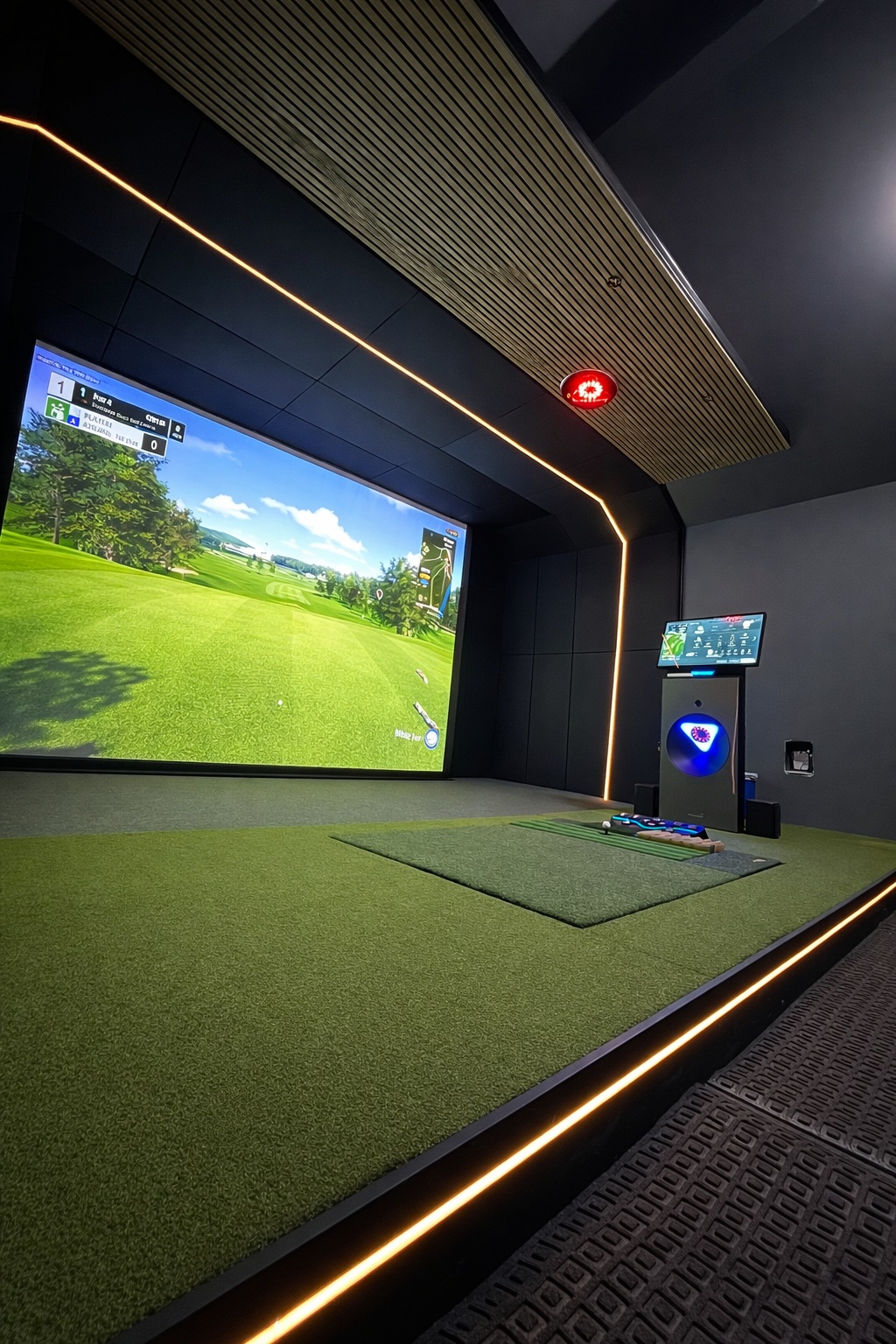
The enclosure is the first thing that defines what your simulator room looks and feels like. It's also one of the most confusing purchases — because "enclosure" means something different depending on who's selling it.
A pipe frame net kit from Amazon is technically an enclosure. So is a custom-fabricated permanent room with acoustic panels and integrated lighting. The word covers an enormous range, and the price difference is equally enormous.
Here's how we actually think about it.
First: Do You Have Enough Space?
Before you choose an enclosure, you need to know if your space can support one at all. This is the question that comes before every other question.
| Dimension | Minimum | Comfortable | Notes |
|---|---|---|---|
| Ceiling height | 9 ft | 10 ft+ | 9ft works for most golfers through 7-iron. Driver swings comfortably need 10ft+. Taller players (6'3"+) should plan for 10ft minimum. |
| Width | 10 ft | 14 ft | 10ft is workable but tight. 14ft gives comfortable room for both right and left-handed players without repositioning the tee. |
| Depth (total room) | 15 ft | 18 ft | Breaks down as: ~1ft behind screen + 10–12ft from screen to ball + 5–7ft behind the golfer for the swing. |
A standard two-car garage (20ft × 20ft, 8–10ft ceiling) works well for most builds. A standard basement with 9ft ceilings is functional for most golfers. Low-ceiling basements (7–8ft) need a specific solution — the Murphy Simulator or a retractable setup where ceiling clearance can be worked around.
Ceiling height beats everything else. You can work around a narrow room with the right enclosure. You can't swing a driver with a 7-foot ceiling. Know your ceiling height before you do anything else.
Why the Enclosure Choice Matters So Much
Your enclosure does three jobs:
- Safety — Contains errant shots and protects the room, the equipment, and the people in it. This is non-negotiable. A golf ball at 100+ mph that misses the screen is a real hazard.
- Immersion — A well-built enclosure makes the simulator feel like a sim room, not a garage project. That matters for how much you actually use it.
- Space management — Some enclosures require the room to be permanently dedicated; others fold away entirely. This is often the deciding factor for garages and multi-use spaces.
The mistake we see most: People buy the cheapest enclosure to save money for the launch monitor, then regret it within a year. The enclosure is what you interact with every single time you use the simulator. Don't underspec it.
The Main Enclosure Types
Permanent Pipe Frame (Carl's Place, SimSpace)
PermanentThe most common setup for dedicated simulator rooms. A metal pipe frame supports an impact screen, side barrier panels, and a ceiling baffle — the side walls and ceiling fabric are the impact protection. It's a fully enclosed system by design: errant shots hit the fabric barriers, not your walls.
Carl's Place C-Series and SimSpace are the two we spec most often. Both include foam inserts that protect the pipe frame itself from direct hits, and optional side netting extensions for extra coverage on hard shanks.
- Best for dedicated basements, garages, or permanent sim rooms
- High customization — screen size, side panel configuration, screen material
- Can be disassembled and moved, though it's a project
- Pairs well with any floor-based or overhead launch monitor
Retractable (Sportscreen, GungHo)
RetractableMotor-driven rollers mounted to the ceiling that lower the screen and side curtains into position. When not in use, the whole system rolls up and disappears — you get your garage or living room back. We've done a lot of GungHo installs over the last two years and it's become a go-to for multi-use spaces.
- Best for garages, bonus rooms, or any shared-use space
- Raises and lowers in under a minute
- Cleaner aesthetic than a permanent frame when retracted
- More complex installation — ceiling mounting is critical
Foldable (Murphy Simulator)
FoldableA cabinet-style unit that folds completely closed when not in use. The screen, hitting surface, and side barriers all fold into a single cabinet footprint. When closed, it's 24" deep and looks like a piece of furniture. When open, you have a complete sim setup in about 2 minutes.
- Best for spaces where a permanent or retractable setup isn't viable
- High-end residential look — this thing doesn't look like a sports net
- Requires professional installation
- Higher upfront cost but solves a real problem for space-constrained buyers
Custom Build (Wood Framing / Room Makeover)
CustomFor builds where the simulator should feel like it was always part of the room. This means custom wood framing and carpentry for built-in screen surrounds, structural modifications to optimize room dimensions, and fully custom padded wall and ceiling environments — 3D-designed, custom upholstered, with integrated lighting and your choice of materials.
This is what separates a "simulator in a room" from a dedicated golf room. We've done builds at this level that end up in architectural features and Instagram. It's not for every project — but when the goal is that result, nothing else gets you there.
- Best for premium dedicated rooms and high-end residential builds
- Full 3D design before any build begins — see it before we build it
- Custom padded walls and ceiling (3 tiers from $2.99/sqft to custom upholstered)
- Built-in carpentry, custom putting floors, integrated LED lighting
- Pairs with any enclosure type or screen system
Impact Protection: What's Included and What's an Upgrade
Full enclosure systems — Carl's Place, SimSpace, GungHo, Murphy — include their own containment structure as part of the design. The side barriers, ceiling baffles, and screen surround are the protection. That's working as intended.
Where padding becomes an additional consideration is in the walls and ceiling of the surrounding room — the surfaces beyond the enclosure footprint that can still take hits from severe mishits or shanks that clear the enclosure barriers.
We offer three padding tiers as part of every build:
- Foam-backed carpet tiles (~$2.99/sqft) — functional, affordable, easy to replace. Good for garages and first builds.
- Acoustic wedge foam panels (~$4.99/sqft) — better aesthetics, significant noise reduction, modular replacement. The most common upgrade.
- Custom upholstered memory foam (from $4,000) — full custom fabrication, your choice of fabric and color, used in dedicated sim rooms and commercial facilities.
For bare-room or custom-frame installs without a full enclosure, wall and ceiling padding isn't optional — it's the primary protection. See our Enclosures gear page for full details on padding options and what we recommend at each build tier.
How to Choose
| Your Situation | Right Enclosure |
|---|---|
| Dedicated room, never moving it | Permanent pipe frame (Carl's Place or SimSpace) |
| Garage or shared space, need to reclaim it | Retractable (GungHo or Sportscreen) |
| No room to dedicate, want premium look | Foldable (Murphy Simulator) |
| Want the room to look like it was designed that way | Custom build — wood framing, room makeover, padded environment |
| Basement with fixed ceiling height under 9' | Talk to us first — ceiling height changes everything |
If you're not sure which applies to your space, the fastest path to the right answer is a room design conversation. We do those for free — and it usually takes 15 minutes to know exactly what will work.
Launch House Golf designs and installs custom golf simulators across the US. Veteran-owned. 200+ builds. 48 states.